
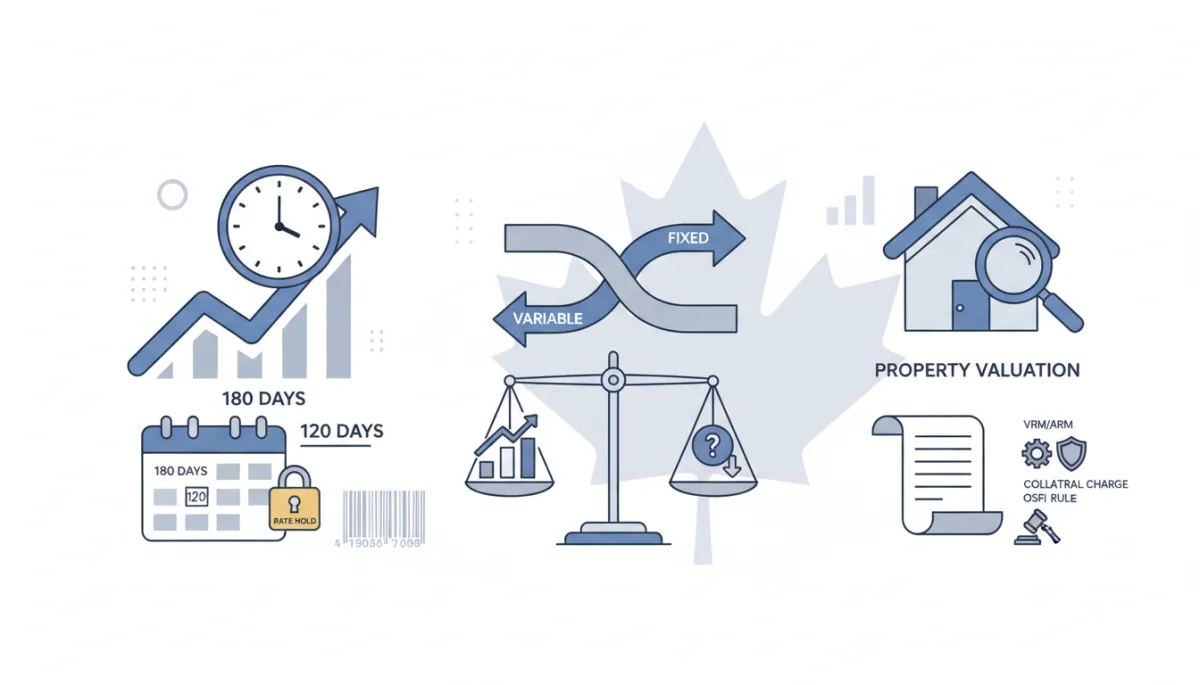
2026 Mortgage Cliff: Renewal Strategy for Canadians
Mortgage Cliff, Renewal Strategy, Fixed Vs Variable, OSFI Rules, Property Valuation
The 2026 Mortgage Cliff: A Four-Step Renewal Strategy for Canadian Homeowners
Approximately 1.2 million Canadian households are heading toward a “2026 Mortgage Cliff” as ultra‑low pandemic‑era rates reset higher. For many in the Greater Toronto Area (GTA), this renewal could mean hundreds of dollars more per month. The Affordable Homes and Condos - Ali Bolourchi Real Estate (A.B.R.E.) Team has developed a practical four‑step framework to help professionals and families turn this stressful moment into a strategic opportunity instead of a financial shock.
Why the 2026 Mortgage Cliff Matters Now
During 2021–2022, many Canadians locked in mortgages at record‑low rates. As the Bank of Canada later raised its policy rate, borrowing costs climbed. Today, as of mid‑September 2026, the overnight rate sits around 2.25% and the prime rate at about 4.45%, with insured five‑year fixed rates often in the 4.1%–4.8% range and variable rates closer to 3.3%–3.6% for well‑qualified borrowers. That gap can translate into a significant change in monthly payments when your term expires.
The Bank of Canada estimates that many borrowers renewing in 2026 could see average payment increases of around 6%, with some facing jumps of 15–20% depending on their original rate and product. In high‑priced markets like the GTA, even a 10% increase can strain cash flow. The good news: with the right Renewal Strategy, you can regain control long before your lender sends that 21‑day renewal notice.
Step 1: Timeline Strategy – Start 180 Days Before Maturity
Most households leave renewal planning until the last month. In a Mortgage Cliff environment, that is simply too late. A disciplined Timeline Strategy gives you room to compare options, negotiate, and adjust your budget with less stress.
180 Days Out: Gather Your Documents and Numbers
Find your original mortgage commitment letter. This document shows your original rate, term, amortization, and any special conditions. It is the baseline for understanding how far your payments may move at renewal and what penalties may apply if you break early.
Review your remaining amortization and balance. A shorter remaining amortization means higher payments, so you may want to explore extending it modestly to keep payments manageable, if allowed by your lender and overall goals.
120 Days Out: Secure a Rate Hold and Compare Lenders
Most lenders in Canada will offer a rate hold up to about 120 days before maturity. This protects you if rates rise before your renewal date, while still allowing you to benefit if rates fall and you renegotiate. In a market where fixed rates have been edging upward with bond yields, a rate hold is a simple but powerful risk‑management tool.
💡 Pro Tip from the A.B.R.E. Team: Do not wait for your lender’s auto‑renewal offer. Start conversations with your bank, a mortgage broker, and a trusted real estate professional at the 120‑day mark to compare true apples‑to‑apples options.
Step 2: Fixed vs. Variable – Balancing Cost and Stability
Choosing between Fixed Vs Variable at renewal is less about guessing future rates and more about matching your risk profile, career stability, and cash‑flow needs to the right product. The 2026 rate landscape creates a genuine trade‑off: variable rates are currently lower, but fixed rates provide payment certainty in an uncertain economy.
Current Market Snapshot: Fixed vs. Variable
Fixed rates: Insured five‑year fixed rates often land around 4.1%–4.8%, with posted rates higher. These are influenced by Government of Canada bond yields, which have been volatile since early 2026.
Variable rates: Insured five‑year variable rates can be as low as roughly 3.3%–3.6%, typically expressed as prime minus a discount (for example, prime – 1.00%).
Key Trade‑Offs to Consider
Payment stability: A fixed rate locks in your payment for the term, which is attractive if your household budget is tight or your income is variable. Variable rates can change if the Bank of Canada adjusts its policy rate, which then flows through to prime.
Penalty risk and Interest Rate Differential (IRD): Breaking a fixed‑rate mortgage early can trigger a large Interest Rate Differential penalty, especially if current rates are lower than your contract rate. Variable mortgages usually have simpler, smaller penalties (often about three months’ interest), offering more flexibility if you plan to sell, refinance, or upgrade to a new home or condo in the GTA within the term.
Flexibility: If you expect lifestyle changes—career moves, family growth, or a relocation within the GTA—variable or shorter‑term fixed products can provide more room to maneuver without punitive costs.
Rate volatility: While many economists expect gradual, measured moves from the Bank of Canada, there are no guarantees. If a payment increase of a few hundred dollars would cause significant stress, a fixed rate can function as insurance against volatility.
💡 Supportive Insight: Many GTA professionals choose a “hybrid” approach—splitting the mortgage between fixed and variable portions—to balance savings potential with stability. Ask your lender or broker whether this is available for your renewal.
Step 3: Critical Details – VRM vs. ARM, Registration Type, and OSFI Rules
Beyond the headline rate, several structural details can dramatically affect how your mortgage behaves through the next cycle. Understanding these mechanics turns you from a passive borrower into an informed decision‑maker—fully aligned with the A.B.R.E. Team’s focus on transparency and client empowerment.
VRM vs. ARM: How Trigger Rates Work
Variable‑Rate Mortgage (VRM) with fixed payments: Your interest rate moves with prime, but your payment may stay the same until it hits a trigger rate—the point where your entire payment is going to interest. Once triggered, the lender may increase your payment, extend your amortization, or require a lump‑sum payment to bring the mortgage back on track. Many households hit their trigger rate during the rapid rate hikes of 2022–2023.
Adjustable‑Rate Mortgage (ARM): Here, the interest rate and payment both move when prime changes. You feel the impact of rate moves immediately, but you are less likely to quietly build up negative amortization or hit a trigger event, because your payment adjusts as you go.
At renewal, ask your lender to clarify whether your product is VRM or ARM and how future rate changes will affect your payment, amortization, and flexibility. This is especially important if you already extended your amortization during the last round of rate hikes.
Standard vs. Collateral Charge Registration
Standard charge: Your mortgage is registered for the actual amount borrowed. This structure is generally easier—and often cheaper—to move (“switch”) to another lender at renewal because the new lender can rely on the existing registration in many cases, reducing legal and appraisal costs.
Collateral charge: The mortgage may be registered for more than the original loan amount (for example, 125% of the property value) and can secure multiple products, such as lines of credit. While flexible for borrowing, it can be harder and more expensive to switch lenders, limiting your negotiating power at renewal.
Before you sign a new term, confirm which registration type you currently have and what will be used going forward. This detail can quietly determine how much leverage you truly have in future negotiations.
OSFI Rules and the “Straight‑Switch” Advantage
Canada’s banking regulator, OSFI, has made one aspect of renewal easier for many borrowers. Under current guidance, lenders are not required to re‑apply the mortgage stress test for most uninsured “straight‑switch” renewals—that is, when you move your mortgage to a new lender without increasing the principal or extending the amortization. This can be a powerful tool during the Mortgage Cliff, especially if your income has not kept pace with rates or if you are already stretched.
📌 Key Takeaway: If you keep your balance and amortization the same, you may be able to switch lenders and access a better rate without re‑qualifying under today’s higher stress‑test rate. This is where strong Renewal Strategy and professional advice can unlock real savings.

Accurate property valuation can shift negotiations in your favour at renewal.
Step 4: Execution & Leverage – Using Property Valuation to Your Advantage
Even in a challenging rate environment, your home or condo is more than a liability—it is an asset that can provide leverage. The final step in managing the 2026 Mortgage Cliff is executing your chosen plan with a clear, data‑driven understanding of your Property Valuation.
Why Property Valuation Matters at Renewal
Loan‑to‑Value (LTV) ratio: A higher current value relative to your mortgage balance means a lower LTV. Lenders often reserve their most competitive rates for lower‑risk borrowers, and a strong LTV positions you in that category, even in a cautious post‑Mortgage Cliff environment.
Negotiating leverage: If you can demonstrate that your GTA property holds solid value—through a recent appraisal or a detailed comparative market analysis (CMA)—you are better equipped to negotiate not just rate, but also fees, prepayment privileges, and other terms.
Strategic options: A clear valuation can reveal whether it makes sense to refinance, consolidate higher‑interest consumer debt, or even right‑size into a more affordable home or condo while preserving equity.
In markets like Toronto, where prices have softened from peak levels but remain high, subtle differences in valuation can materially affect your renewal options. A $30,000–$50,000 swing in appraised value can shift you across key LTV thresholds and open—or close—doors with certain lenders.
Putting It All Together: A Practical Renewal Checklist
180 days before maturity: Retrieve your original mortgage commitment letter, confirm your product type (fixed, VRM, ARM), and review remaining amortization.
120 days before: Secure a rate hold with your current lender and begin shopping alternatives. Ask specifically about penalties, IRD calculations, and whether a straight‑switch is possible under current OSFI Rules.
90–60 days before: Obtain a professional opinion of value for your property—through an appraisal or a CMA from a knowledgeable GTA agent like the A.B.R.E. Team—and use that data to refine your LTV and negotiation strategy.
30 days before: Lock in your chosen product (Fixed Vs Variable or hybrid), confirm all conditions in writing, and update your household budget to reflect the new payment and any changes in amortization.
Turning the 2026 Mortgage Cliff into a Strategic Advantage
The 2026 Mortgage Cliff is real—but it does not have to be a crisis. By starting early, understanding the nuances of Fixed Vs Variable products, paying attention to VRM and ARM mechanics, knowing how your mortgage is registered, and using OSFI’s straight‑switch flexibility to your advantage, you can navigate renewal with clarity and confidence. Your property’s valuation is not just a number on paper; it is a core part of your negotiating power and long‑term wealth plan.
At Affordable Homes and Condos - Ali Bolourchi Real Estate (A.B.R.E.) Team, we combine deep GTA market expertise with digital tools to help you model different renewal scenarios, understand payment impacts, and explore options from “hold and renew” to “refinance and right‑size.” Our goal is to ensure your mortgage supports your life—not the other way around.
If your mortgage term is ending in 2026 or 2027, now is the time to act. Take our free First‑Time Home Buyer Eligibility Quiz if you are considering a move, browse affordable homes and condos across the GTA, download our complimentary buyer’s and seller’s guides, or contact the A.B.R.E. Team for a personalized renewal and Property Valuation review. With the right strategy, your Mortgage Cliff can become a stepping stone toward a more secure and affordable future.