

Richmond Hill Condo Market Trends 2026
Real Estate, Richmond Hill Condos, Market Trends 2026
Richmond Hill Condo Market Trends January–July 2026: What Investors Need to Know
A data-driven review of Richmond Hill condo performance from January to July 2026, with a focus on North and South Richvale, for investors evaluating returns, risk and timing.
1. How Richmond Hill Condo Sales Have Shifted Since 2023
Between 2023 and mid‑2026, Richmond Hill’s condo market has moved from a tighter, more competitive environment to a slower, inventory-heavy cycle. In 2023, multiple-offer situations were still common, and many condo units traded close to or above asking, supported by limited supply and buyers trying to get into the market before further rate hikes. By January–July 2026, the picture is different: months of inventory hovered around 5.6–6.2, signalling a clear buyer’s market across much of the year (Valery.ca / TRREB data).
From an investor’s standpoint, that shift matters more than the headlines about “prices up” or “prices down.” A higher level of inventory and longer days on market generally mean more negotiation room, more conditional offers, and less urgency to bid aggressively. As Ali Bolourchi, BSc, MS, PSA, ABR®, Broker of the A.B.R.E. Team with REMAX® Your Community Realty and founder of The4Sale.com, notes, this is a market where patient capital can secure better pricing and terms, provided investors are disciplined on the numbers: cap rate, net operating income (NOI) and price per square foot.
2. Average Sale Price: January–July 2026 in Context
Looking specifically at January through July 2026, average condo sale prices in Richmond Hill have been volatile month to month, but overall they sit in a relatively narrow band in the low‑ to mid‑$500,000s. According to TRREB-based data summarized by Valery.ca, the average sold price moved roughly as follows:
January: ≈ $531,000 (median ≈ $510,000)
February: ≈ $575,000 (median ≈ $580,000)
March: ≈ $579,000 (median ≈ $595,000)
April: ≈ $562,000 (median ≈ $535,000)
May: ≈ $554,000 (median ≈ $550,000)
June: ≈ $525,000 (median ≈ $510,000)
July: ≈ $576,000 (median ≈ $550,000)
For investors comparing this to 2023, the key takeaway is that prices have not collapsed; instead, they have flattened with seasonal swings. March 2026 delivered the highest median prices, while June presented a dip that created better entry points. Over a 12‑month window to September 2026, the median condo price in Richmond Hill sits around $540,000 (Homeh.com, BuyRealty.ca), reinforcing the idea of a sideways market rather than a strong uptrend.
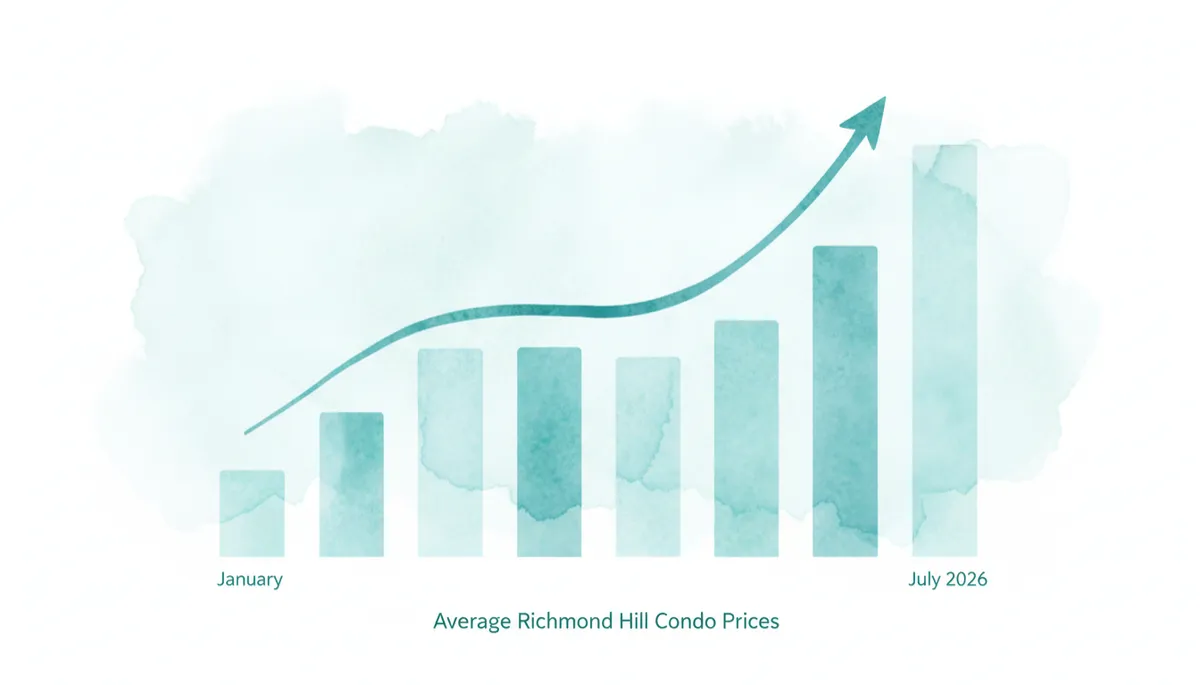
Seasonal volatility masks an overall sideways price trend in early 2026.
3. Sales Divided by New Listings: Reading the Supply–Demand Balance
A more useful metric for investors than price alone is the ratio of sales to new listings. It tells you how quickly inventory is being absorbed. Across Richmond Hill condos in early 2026, sales volumes rose from 16 units in January to a peak of 49 in June, while new listings also increased into the spring. With months of inventory sitting around 5.6–6.2, the sales‑to‑new‑listings ratio has generally favoured buyers: a lot of product, but only a portion of it clearing each month (Valery.ca; Listing.ca).
Zoom in on North Richvale and the story sharpens. From January to July 2026, North Richvale saw 46 condo sales against 122 new listings (blog.ali.realtor), implying that only about one in three listings actually sold in that period. That is classic buyer’s-market territory. For investors, this means more choice and more leverage to negotiate on price, conditions and closing dates—especially on units that have been sitting for several weeks.
💡 Pro Tip (Ali Bolourchi): In a low absorption market, focus on motivated sellers—units with multiple price reductions or 40+ days on market—rather than chasing the newest listings at full ask.
4. Days on Market: How Fast Are Condos Actually Moving?
Days on market (DOM) is a practical indicator of market efficiency and negotiating power. In January 2026, Richmond Hill condos typically required about 42–45 days to sell. By March and June, that number improved to roughly 25 days, before drifting back into the low‑30s by July (Valery.ca; Listing.ca). The trend follows a familiar pattern: slow winter, brisk spring, then a modest summer slowdown.
North Richvale condos, however, show a slightly different profile. Q1 2026 data indicates average DOM in the low‑40‑day range for condo apartments (Team Zold), which is slower than the citywide condo average but consistent with a more established, higher‑price neighbourhood. In other words, buyers are more selective, and sellers often have the financial capacity to wait for their price. Investors targeting North Richvale should be prepared for longer negotiations and fewer “fire‑sale” opportunities, but also for more stable tenant demand once a unit is acquired.
5. Sale Price as a Percentage of List Price
Across Richmond Hill, the sold‑to‑asking price ratio for condos from January to July 2026 has stayed mostly between 96% and 98%:
January: ≈ 96.3%
March peak: ≈ 98.2% (strongest month for sellers)
May–June: ≈ 96.0–96.5%
July: ≈ 96.9%
For investors, this confirms that negotiation room exists, but is not unlimited. You are not typically buying at 85% of ask; you are negotiating in the low‑ to mid‑90s, depending on how realistic the list price is. North Richvale again stands out: condo apartments there sold at about 99% of list price in Q1 2026 (Team Zold), which is effectively full price. That suggests a tight micro‑market with well‑priced listings and buyers who value the location enough to pay close to ask.
South Richvale, by contrast, shows a sale‑to‑list ratio around 93% when looking at all property types (Team Zold). While condo‑specific figures are limited, this lower ratio implies more flexibility at the negotiation table, especially on higher‑end product and older stock.
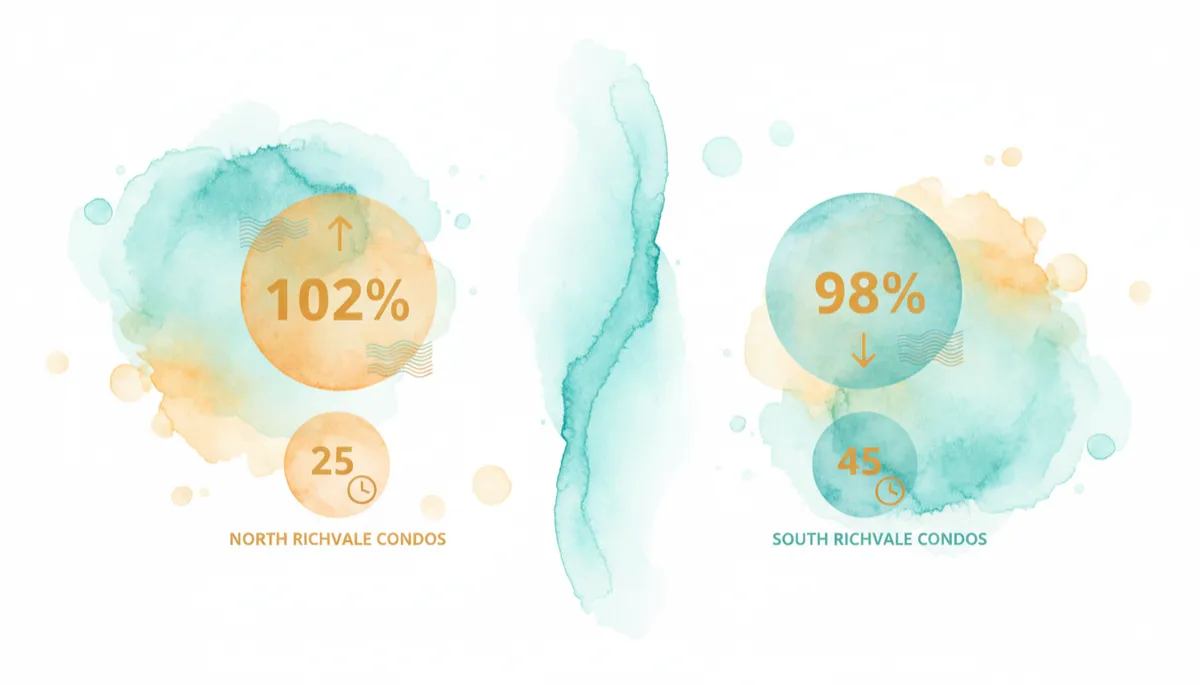
North Richvale commands near-ask pricing; South Richvale offers more room to negotiate.
6. North vs South Richvale Condos: A Practical Comparison
North Richvale: Higher Prices, Stronger Tightness
In North Richvale, condo investors are generally paying in the $600,000–$675,000 range. Q1 2026 condo apartment sales averaged around $636,000 with a median of about $600,000 and a sale‑to‑list ratio near 99% (Team Zold). Over the January–July window, the sales‑weighted average price for condos sits closer to $672,789 across 46 sales (blog.ali.realtor). DOM is in the low‑40‑day range, slightly slower but still healthy.
These figures place North Richvale above the citywide median (≈$540,000), reflecting its status as a more established, amenity‑rich neighbourhood. From Ali Bolourchi’s perspective, North Richvale appeals to investors who prioritize tenant quality and long‑term stability over chasing the absolute lowest purchase price. Units here may not look cheap on paper, but they often deliver consistent occupancy and lower turnover, which matters when you are underwriting NOI over a 10‑year horizon.
South Richvale: Lower Asking Prices, Less Clarity on Condos
South Richvale is traditionally known for high‑end detached homes, with a median sale price near $1.88M for all property types in early 2026 (Team Zold). Condo‑specific data is thinner, but September 2026 listing data shows a median asking price around $555,000 for condos, notably below North Richvale’s median asking price of roughly $655,000 (Valery.ca). In that same month, South Richvale recorded 22 condo sales, signalling active demand but not necessarily premium pricing.
For investors, the implication is that South Richvale may offer slightly lower entry prices on condos, but with more variability in product type and quality. With sale‑to‑list ratios around 93% on a broader property basis, buyers here can often negotiate more aggressively—useful if you are seeking value‑add opportunities or repositioning plays.
📌 Key Takeaway: North Richvale condos trade at a premium but deliver near‑ask pricing and solid absorption. South Richvale condos appear cheaper on paper and more negotiable, but require closer due diligence on building quality, management and long‑term rentability.
7. What the Market Data Does Not Tell Investors
Average prices, DOM and sale‑to‑list ratios are essential, but they do not tell you whether a specific condo is a good investment. They do not reveal the rent you can realistically achieve, the monthly fees you will pay, or the capital you will need for repairs and upgrades. They also do not account for financing structure—interest rates, amortization, loan‑to‑value—or your own tax situation. Those are the variables that determine whether the deal works on a cap‑rate and cash‑flow basis.

Numbers on paper matter less than net cash flow after every hidden cost.
8. Rent: Translating Purchase Price into Income
Neither TRREB nor public market snapshots publish building‑by‑building rent rolls. Yet for investors, rent is the foundation of value. A $600,000 North Richvale condo generating $2,700 per month in rent performs very differently from a $550,000 South Richvale unit renting for $2,300. Assuming similar expenses, the first may deliver a higher gross yield despite the higher purchase price.
Ali Bolourchi often advises clients to underwrite conservatively: work from current market rents, not the most optimistic projections, and stress‑test for modest rent growth. In practice, that means:
Using recent, comparable leases in the same building or immediate area.
Accounting for potential vacancy or tenant turnover between leases.
Adjusting expectations for units with inferior layouts, views or parking.
Two condos with identical purchase prices can have very different cap rates once rent is normalized for size, finishes and tenant profile. That is why The4Sale.com emphasizes price per square foot and rent per square foot in every analysis, not just headline sale price.
9. Fees: The Silent Drag on Cash Flow
Monthly condo fees can make or break an investment. Market reports do not show whether a unit carries $450 or $950 in maintenance fees, nor whether there are upcoming increases. In North Richvale, many established buildings offer larger floor plans but also higher fees to fund amenities and long‑term reserve funds. In South Richvale, newer or more modest buildings may advertise lower fees, but investors must confirm whether those fees are sustainable or temporarily discounted to attract buyers.
When Ali’s team underwrites a condo for an investor, fees are treated as a fixed operating expense alongside property taxes and insurance. The question is simple: After fees, does the rent still support your target cap rate? If not, even a “good deal” on purchase price can become a poor performer in your portfolio.
10. Costs: Beyond the Purchase Price
Market trend charts also ignore the full stack of ownership costs that investors must budget for. These include:
Land transfer tax (provincial and, for Toronto properties, municipal—Richmond Hill investors avoid the latter).
Legal fees, inspection costs and status certificate reviews.
Initial repairs, upgrades and furnishing for rental readiness.
Ongoing repairs, insurance and potential special assessments.
In higher‑end pockets like North and South Richvale, finishes and tenant expectations are also higher. A unit that looks “fine” by downtown standards may require additional capital to compete locally. Experienced investors often allocate a contingency reserve—5–10% of gross rent—for maintenance and unexpected costs. That line item never appears in a market report, but it shows up quickly on your P&L.
11. Financing Considerations in a 2026 Rate Environment
Finally, the 2026 condo data does not capture how your financing will affect returns. Interest rates, stress test requirements and lender appetite for investor‑owned condos all shape the true cost of capital. A unit that appears to break even at 3% interest may move negative at 5–6%, especially once fees and vacancy are included.
Ali’s approach at The4Sale.com is to model several financing scenarios before recommending an acquisition. That might include:
Comparing fixed vs variable rates and different amortization periods.
Testing higher‑rate scenarios to see where cash flow turns negative.
Evaluating whether a higher down payment improves debt coverage enough to justify tying up additional equity.
⚠️ Important: The information in this article is general in nature and is not legal, tax or financial advice. Always consult your own professional advisers before making financing or investment decisions.

Scenario-based financing analysis turns raw market data into actionable strategy.
12. Pulling It Together: How to Use These 2026 Trends
From January to July 2026, Richmond Hill’s condo market—especially in North and South Richvale—has offered investors a mix of stability and opportunity. Prices have stayed in a relatively tight band, sales‑to‑new‑listings ratios and months of inventory point to a buyer‑friendly environment, and sale‑to‑list ratios confirm that negotiation room exists without signalling distress. North Richvale commands higher prices and near‑ask sales, reflecting stronger perceived value and tenant demand. South Richvale appears more negotiable and slightly cheaper on the condo side, but requires careful building‑level due diligence.
For investors, the real work starts where the public data stops: validating rent, quantifying fees, projecting all‑in costs and structuring financing. That is where a data‑driven, investor‑focused brokerage adds value. At The4Sale.com – Ali Bolourchi, Broker, REMAX® Your Community Realty (Commercial) – every potential acquisition is screened against your criteria using comparable sales, cap rate and income analysis, not just headline averages. The goal is simple: a valuation you can act on and defend, and a purchase that supports your long‑term strategy across the GTA and York Region.
If you are considering a Richmond Hill condo—whether in North Richvale, South Richvale or another neighbourhood—start with the numbers, then drill down to the building, the unit and your financing. Used properly, the January–July 2026 data is not just a snapshot of the market; it is a framework for disciplined decision‑making in a shifting interest‑rate environment.
Next Steps for Investors
If you want to translate these trends into a specific investment plan, consider:
Scheduling a one‑on‑one consultation with Ali Bolourchi to review your goals and risk tolerance.
Requesting a free commercial or investment property evaluation to benchmark your current holdings.
Using The4Sale.com tools to search commercial and investment listings by address or MLS® number and to run preliminary investment calculators.
With more than two decades in GTA real estate and a network of trusted advisers, the A.B.R.E. Team at REMAX® Your Community Realty is positioned to help you navigate the Richmond Hill condo market with clarity—whether you are adding your first investment condo or rebalancing a larger portfolio.